Every year, somewhere in the ninety days before your license plate expires, your vehicle owes the state of North Carolina a safety inspection. Most Brevard drivers treat the NC vehicle safety inspection as a formality, right up until the year something fails and the tag renewal will not go through. Knowing what actually gets checked, what does not, and why a vehicle registered here in Transylvania County goes through a shorter process than the same vehicle registered in Asheville can save you a bad week.
This is a plain walk through the annual car inspection Transylvania County NC drivers deal with each year: what the inspector looks at, what changed recently, what tends to fail, and what you can look over yourself in your own driveway the week before you come in. The rules are the same in town in Brevard as they are out in Pisgah Forest, Penrose, Cedar Mountain, Rosman, Lake Toxaway or Etowah, and so is the part most people find surprising.
Why the inspection is really about your license plate
The inspection is not a standalone errand. It is attached to your registration. According to the North Carolina Division of Motor Vehicles, a motor vehicle registered in North Carolina must pass an annual safety inspection before its registered owner can renew its vehicle registration. If the inspection does not happen by the due date, the registration is blocked until the vehicle is inspected.
A failed bulb is a small thing. A failed bulb the day your tag expires is not.
The timing rule gives you room, and most people never use it. Inspections can be conducted no more than ninety days before the license plate and registration expire. That is a three month window, not a deadline day. If your plate is up at the end of November, you can come in as early as September. Do that, and a torn wiper blade or a worn set of tires becomes a repair you schedule at your convenience instead of an emergency between you and a legal tag.
What the NC vehicle safety inspection in Brevard actually covers
The list is set in state law, not made up shop by shop. Under the statute that defines the scope of inspection, a safety inspection covers brakes, lights, horn, steering mechanism, windshield wipers, directional signals, tires, mirrors, and the exhaust system and emissions control devices.
The DMV describes the same list in everyday terms: headlights, accessory lights, directional signals, foot brake, parking brake, steering, tires, horn, rearview mirror, windshield wipers, exhaust system, and emission control components.
A few of those deserve a closer look.
Brakes means both of them. The foot brake and the parking brake are separate line items. A parking brake that has quietly stopped holding is extremely common on vehicles that live in a flat driveway and never need it.
Lights means all of them. Not just the headlights. Accessory lights, the license plate light, brake lights, and turn signals all count. The plate light is the single easiest one to miss, because you almost never stand behind your own car at night.
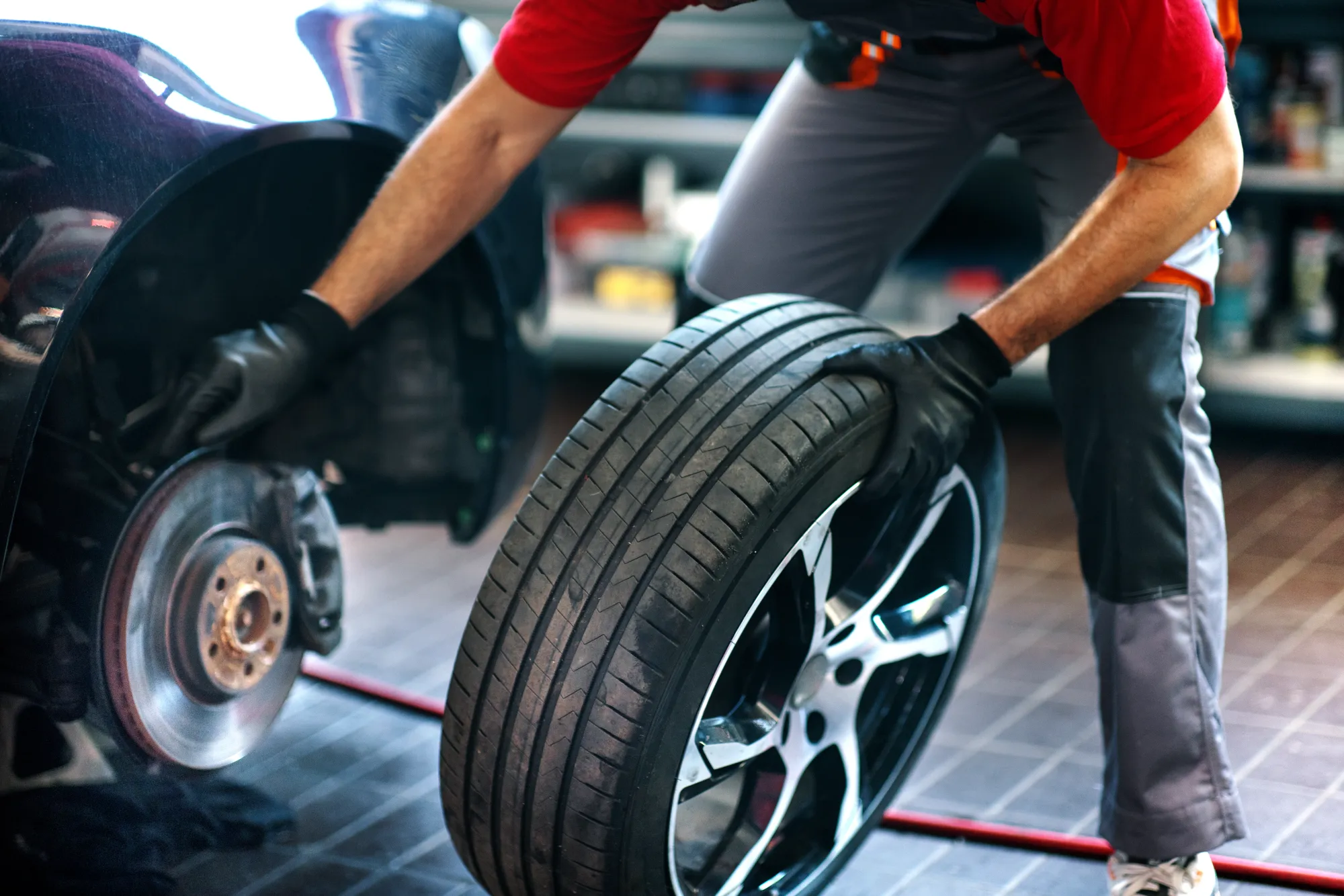
Tires have a legal floor. State law treats a passenger vehicle tire as unsafe when it has less than two thirty-seconds of an inch of tread depth at two or more locations around the circumference of the tire, in two adjacent major tread grooves. Heavier vehicles rated over 10,001 pounds face a stricter standard: four thirty-seconds on steering axle tires in any major groove, and two thirty-seconds on the non-steering axles. That last detail matters to local fleet and work truck owners around Brevard more than it does to a commuter.
The horn has a spec. It has to be capable of emitting sound audible under normal conditions from a distance of not less than 200 feet. A horn that has faded to a polite chirp is a real failure item.
The flip side is just as useful to know: nothing outside that list is what the inspection is judging. This is a safety equipment check, not a bumper to bumper verdict on your vehicle.
North Carolina emissions inspection counties, and why Transylvania is not one
Here is where Brevard drivers get conflicting advice, usually from a coworker or a relative who lives over the mountain.
North Carolina runs an on-board diagnostic emissions inspection program, but only in nineteen counties. Per the DMV, those counties are Alamance, Buncombe, Cabarrus, Cumberland, Davidson, Durham, Forsyth, Franklin, Gaston, Guilford, Iredell, Johnston, Lincoln, Mecklenburg, New Hanover, Randolph, Rowan, Union and Wake. Where the program applies, the emissions inspection is done at the same time as the safety inspection.
Transylvania County is not on that list. Buncombe County, one ridge over, is. Henderson County, where a lot of Brevard drivers do their shopping, is not.
So if you commute to Asheville and hear a coworker complain about a check engine light costing them their inspection, they are not exaggerating and they are also not describing your situation. Their vehicle is registered in one of the North Carolina emissions inspection counties. Yours, registered here, faces the safety portion only.
What are they going through that you are not? Under the statute, an emissions inspection is a visual inspection of the vehicle’s emissions control devices to confirm they are present, properly connected and the correct type for the vehicle, plus an analysis of the data coming off the on-board diagnostic equipment. The North Carolina Department of Environmental Quality, which runs the program side of it, describes OBD as a system that monitors engine components, emissions controls, sensors and the vehicle’s own computer, and that tells the driver something is wrong by illuminating the check engine light.
Even inside those nineteen counties there are carve outs: some light duty vehicles less than three years old or with fewer than 70,000 miles, vehicles twenty years old or older, diesel operated vehicles, and farm registered vehicles.
What counts is where the vehicle is registered, not where you get the work done. A vehicle registered at a Brevard address is outside the emissions program even if you have it serviced in Hendersonville or Asheville.
None of which changes your day here in Brevard. Still worth knowing, though: a check engine light will not fail your safety inspection in Transylvania County, but it is still your vehicle telling you something. Do not let the absence of an emissions test talk you into ignoring it.
Window tint is no longer checked, and that surprises people
This is the part most articles on North Carolina inspections still get wrong, because they were written before the rule changed.
Window tint used to be measured as part of the safety inspection, with its own separate inspection fee attached. As of December 1, 2025, window tint checks are no longer required as part of a North Carolina safety inspection, and the separate tint inspection fee went away with the requirement. The state’s stated reason was to simplify the process and reduce cost for drivers.
Two things people get wrong about this, in opposite directions.
Tint is still regulated. The inspection stopped measuring it. The law did not stop caring. Officers can still stop a vehicle, test the tint and issue a citation. What changed is where the check happens, not whether the limit exists.
You do not need to strip your film before your appointment. If you were about to pay someone to remove legal tint because an old blog post told you the inspector would measure it, save yourself the trip. Tint was never in the statutory equipment list to begin with, which is part of why it came off the lane so cleanly.
The failures a Brevard shop sees most often
After enough years of doing this, the pattern is very consistent, and almost every item on it is something the owner could have caught first.
Bulbs. Far and away the most common. License plate lights and accessory lights lead the list, because nobody checks them. A bulb is a small repair and a fast one.
Wiper blades. Rubber in this climate takes a beating from sun, pollen and the wet season. A blade that chatters, streaks, or has started to separate from its frame is a failure, and it is also the thing you least want to discover halfway up 276 in a summer downpour.
Tires at the wear bars. Tread that has come down level with the raised wear bars in two adjacent grooves is the statutory fail point. This is one you can see without any tool at all. Sidewall damage and slow leaks show up here too, and they usually have a cause worth understanding rather than just topping off.
Brakes. Driving around here is not flat driving. Grades in and out of Pisgah, up toward Caesars Head, and along the Blue Ridge Parkway ask far more of a brake system than city miles do, and they wear pads accordingly. Brake condition is worth watching between inspections rather than only at renewal time, and there are habits that make a set of pads last longer.
Steering. A vehicle that wanders or pulls to one side gets attention on the lane, and the underlying cause is usually worn steering or suspension components rather than anything exotic.
Horn. Simple, and simple to overlook, since most of us go months without pressing it.
Exhaust. A loose hanger, a rusted through section, or a damaged component is both an inspection item and a genuine safety issue.
Every one of these has a mechanical cause worth diagnosing rather than patching, which is why the right move on any of them is a technician rather than a parts store guess.
Your Brevard driveway pre-check, the week before
None of this requires tools or expertise. Give yourself fifteen minutes in the driveway a week out.
- Lights. Get someone to stand outside while you work through headlights on low and high, brake lights, reverse, both turn signals, hazards, and the license plate light. Walk behind the car yourself after dark once.
- Wipers. Wet the windshield first. Dry glass hides a bad blade. Look for streaking, chattering, or a torn edge.
- Horn. Press it. That is the whole test.
- Tires. Find the raised wear bars sitting in the grooves. If the tread is level with them, the tire is at the end of its legal life.
- Mirrors. Rearview and outside mirrors intact, secure, and not cracked.
- Parking brake. Set it on a slope and confirm it actually holds the vehicle. There is no shortage of slopes around here to test it on.
- Dash lights. At startup, the warning lights should illuminate briefly and then go out. One that stays lit is worth asking about.
That short list catches the large majority of what fails. Anything on it that does not look right is a conversation to have before your appointment rather than during it.
What happens if your vehicle fails
Not much drama, as long as you used your ninety day window. The vehicle gets the repair it needs, comes back, and is re-inspected. The reason to come in early is precisely so a failure is an inconvenience rather than a crisis with an expired tag attached.
As for what a repair will run: parts and labor pricing moves too often for any blog post to give you a number you could trust. Ask us for a current quote on your specific vehicle, and you will have it before any work begins.
Who is exempt
There are a few real exemptions, and they come up more often around here than you might expect.
Vehicles more than thirty years old are exempt from the annual safety inspection. Vehicles thirty years or older carrying antique plates are exempt from both the safety and emissions inspections. So the 1988 farm truck that still hauls firewood in Rosman is out of the annual inspection cycle entirely.
Exempt from the inspection is not the same as exempt from physics, of course. An older vehicle still needs brakes that stop it and tires that hold the road on a mountain grade.
Getting your NC vehicle safety inspection done in Brevard
The annual inspection is one of the few times a year every vehicle gets a proper set of eyes on its safety equipment. Scheduled early in that ninety day window, it is a useful checkpoint rather than a hurdle.
Charlie’s Tire Center has been Brevard’s trusted auto repair shop since 1971, and we handle the NC vehicle safety inspection Brevard drivers need along with whatever it turns up, for customers all over Transylvania County from Pisgah Forest and Penrose to Rosman, Cedar Mountain and Lake Toxaway. If you are looking for a vehicle inspection near you and want the repair handled in the same place, schedule an appointment and come in before your tag date, not on it.