If you live in Brevard, your vehicle probably spends part of every warm weekend carrying something heavy. Bikes on a hitch rack headed out toward DuPont. Kayaks and a cooler in the bed on the way to the Davidson River. A roof box packed for a few nights in Pisgah National Forest. DuPont State Recreational Forest alone draws more than a million visitors a year according to the N.C. Forest Service, with nearly 180,000 in the single month of July 2021, and almost all of them arrive by vehicle with gear strapped to it.
That is a lot of loaded driving for the cars in this county, and it looks the same coming out of town, Pisgah Forest, Penrose, Cedar Mountain or Rosman. What most people never think about is that a bike rack is not luggage. It is weight, hung in the worst possible place, over and over, on roads with more grade and more curves than the vehicle sees the rest of the year. Here is what a season of it actually does to your tires, your hitch, your rear suspension and your headlights, and what is worth checking before winter.
The weight you are actually carrying to the trailhead
Start with the number, because it surprises people. A common four-bike platform hitch rack weighs roughly 96 pounds empty, and it is rated to carry up to 160 pounds of bikes, with a per-bike limit of 60 pounds. Load it up and you have something in the neighborhood of 250 pounds hanging off the back of the vehicle. That is a passenger and a half, except a passenger sits between the axles and this does not.
Everything on a hitch rack sits behind the rear axle. That makes it a lever. The load pushes the back of the vehicle down and, through the same lever, takes weight off the front. A truck bed full of wet gear does something similar, though less dramatically, because the load sits closer to the axle. A roof box is a different problem again. The weight is small compared to a bike rack, but it sits high, which raises the vehicle’s center of gravity and gives crosswinds something to push against. On US 64 through Penrose and on the climbs up US 276 into Pisgah, drivers with a loaded roof usually notice the vehicle wandering more in gusts and leaning harder in the switchbacks. Roof loads have their own limit, too, set by the vehicle maker and printed in the owner’s manual.
None of this is dangerous by itself. Vehicles are built to carry things. The trouble is that the load is invisible to the driver, the mountain roads amplify it, and nobody adjusts anything before setting off.
What a loaded rack does to your rear tires
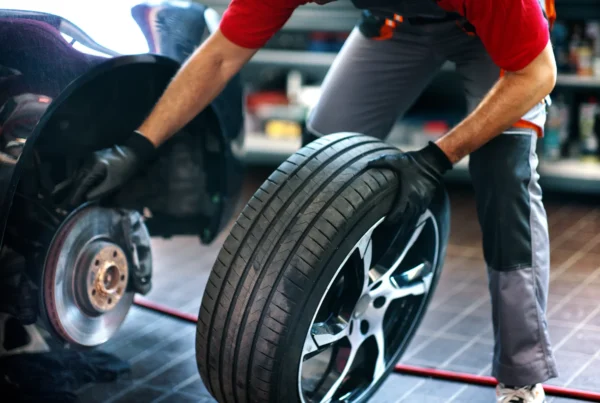
Your rear tires carry the extra weight first, and they are the easiest thing on this whole list to get right.
Every vehicle has a placard, usually on the driver’s door jamb, listing the recommended cold inflation pressure. Cold means before you have driven on the tires, not after a run out to the forest. When the back of the vehicle is carrying a couple hundred extra pounds, running the rear tires soft is exactly the wrong thing to do, and soft is the default condition for most vehicles on the road. The U.S. Government Accountability Office found that more than a quarter of automobiles, and about a third of light trucks, are driven with tires underinflated by 8 psi or more below what the manufacturer recommends.
That matters more with weight in the back than without it. According to the same GAO report, underinflated tires contribute to skidding, hydroplaning, longer stopping distances, flat tires and blowouts, and NHTSA estimated 41 deaths a year from blowouts on underinflated tires alone. Every one of those failure modes is worse on a wet descent off the Blue Ridge with a heavy back end pushing you into the corner.
Cooler weather makes it worse without you doing anything. As fall temperatures settle into Transylvania County, tire pressure falls on its own, so the tires that felt fine in August are genuinely lower in October. Check them cold, set them to the placard number, and check them again once the weather turns.
Then look at the tread itself. A rear tire that has spent a summer carrying weight at the wrong pressure often shows it: more wear on the shoulders than the center, or one rear tire noticeably further along than the other. Uneven rear wear is also a hint that something in the rear suspension or alignment is no longer holding the wheel where it belongs.
Hitch and receiver wear, and why the rating matters
Hitches are rated by class, and the number that matters for a bike rack is tongue weight, which is the downward load the receiver can carry. Class 1 hitches are rated up to 200 pounds of tongue weight, Class 2 up to 350, Class 3 up to 800 and Class 4 up to 1,000. A loaded four-bike rack is not a trivial fraction of any of those, and on a Class 1 hitch it can be most of the rating.
The rule the industry states plainly is that capacity is always limited to the lowest-rated component in the system. Your hitch might be a Class 3, but if the vehicle itself is rated lower, or the rack is rated lower, the smallest number wins. A hitch bolted to a vehicle that was never meant to carry that much does not fail loudly. It flexes, works at its mounting points, and lets the rack sway further with every mile.
Things to look for on the hitch itself after a season of bike rack towing around Brevard NC:
- Play in the receiver. Grab the rack and rock it. Some movement is normal, but a rack that clunks noticeably against the receiver is wearing both parts.
- Rust at the mounting points. Wet gear, road spray and our humidity all live back there, and surface rust on the crossmember is different from rust at the bolt flanges.
- Loose or missing hardware. Hitch bolts are torqued to a spec, and a season of vibration and lever loads can back them off.
- A bent or dropped receiver tube. If the rack sits visibly lower than it did in spring, the hitch, not the rack, may be the reason.
Thinking about hitch installation in Brevard NC
If you are adding a rack for the first time, or the current one has never felt right, hitch installation in Brevard NC is straightforward work when the hitch is matched properly to the vehicle. The important part is sorting out the class and the vehicle’s own ratings before anything is bolted on. We are glad to look at what you are trying to carry and tell you what fits. For what any of this comes to, ask us for a current quote rather than guessing from a number you read online, because parts and labor pricing moves.
Rear suspension repair in Transylvania County starts with worn shocks and sagging springs
Squat is the visible symptom. Load the rack and the back of the vehicle sits lower, the nose points slightly up, and the suspension is compressed before you even start driving. Springs are designed to take that. The problem is doing it every weekend from May through October while driving roads that ask the suspension to work continuously.
Shocks are usually the first thing to give up. Their job is to control the spring, and when they are worn the back of the vehicle keeps moving after the road has stopped asking it to. Loaded, that shows up as a wallowing feeling over dips, a back end that wants to keep going straight when you turn into a switchback, or a bounce that repeats after a bump instead of settling once. Add a couple hundred pounds behind the axle and the same worn shock has considerably more mass to control.
Two checks you can do in the driveway, unloaded:
- The bounce test. Push down hard on one rear corner and let go. It should come back up and settle. If it keeps oscillating, the shock is not doing its job.
- Look for wetness. A shock that is leaking oil down its body has failed, even if the vehicle still feels acceptable.
Also worth noticing: does the vehicle sit level side to side, and does it sit as high in the back as it did a year ago? A spring that has sagged does not announce itself. It slowly changes how the vehicle handles, how the tires wear, and how much travel is left before the suspension bottoms out on a forest road. Between the gear hauling, the grades and the rough secondary roads, rear suspensions in this county work harder than most. Worn rear parts are also one of the reasons a vehicle starts pulling to one side once the weight comes off.
The knock-on effect is braking and steering. A vehicle that is squatted has less weight on the front tires, which is where most of your braking and all of your steering happens. That is the mechanism behind the long, soft, slightly vague stop that people describe when they are loaded, and it is one more reason to keep both ends of the vehicle in good shape before the season rather than after.
Headlight aim and your North Carolina inspection
Here is the one almost nobody connects. When the back of the vehicle squats, the front of the vehicle rises, and the headlights rise with it. They are aimed relative to the vehicle, not the road. If oncoming drivers start flashing you on US 276 after dark, and you have a loaded rack on the back, that is usually the reason and not a burned-out bulb.
North Carolina is specific about this. State law requires headlamps to make a person clearly visible 200 feet ahead, prohibits projecting a glaring light toward drivers within 500 feet, and limits the main bright portion of the beam to no more than 42 inches high at 75 feet ahead of the vehicle. A rear end sitting low enough to tip the beams up can put you outside that. On unlit roads like Cascade Lake Road, badly aimed lights cost you more than a citation. They can be the difference between seeing a deer and not.
It also intersects with your annual inspection. North Carolina’s safety inspection examines headlights, accessory lights, directional signals, foot brake, parking brake, steering, tires, horn, rearview mirror, windshield wipers and the exhaust system. Headlights and tires are both on that list, and both are things a season of loaded driving quietly changes. If you want the background on what the state actually checks, and why Transylvania County drivers skip the emissions portion, we have written about that separately.
Aim is adjustable. Sagging springs that are causing the aim problem are a repair. Knowing which one you have is the point of looking.
What to check after a season of hauling
Trailhead traffic stays heavy well past Labor Day before dropping off sharply. The Forest Service’s own numbers show November through February each drawing fewer than 100,000 visitors at DuPont, compared with that July peak near 180,000. Early fall is the natural time to have the vehicle looked at, before the weather turns and before your inspection comes due.
A short list worth running through:
- Rear tire pressure, set cold to the door placard, and rear tread checked for shoulder wear
- Hitch receiver for play, rust at the mounts, and hardware that has loosened
- Rear shocks for leaks, and a bounce test on both rear corners
- Ride height front and rear, compared with how the vehicle sat in spring
- Headlight aim, especially if anyone has flashed you
- Alignment, if the vehicle wanders, pulls, or the rear tires are wearing unevenly
Most of that is quick to check and easy to catch early. A sagging spring or a worn shock found in September is maintenance. The same part found in February, after it has scrubbed a set of rear tires and dragged your inspection down with it, is a bigger job.
Charlie’s Tire Center has been taking care of Brevard vehicles since 1971, and we see plenty that spend their summers loaded down with bikes and boats. If you have been searching for a shop near you that understands what gear hauling does to a vehicle, we are at 177 N Caldwell St in Brevard, a few minutes from the routes out to DuPont and Pisgah. Bring it in and we will go over the tires, hitch, suspension and lights together, and give you a current quote on anything that needs attention. Schedule an appointment and get it sorted before winter.