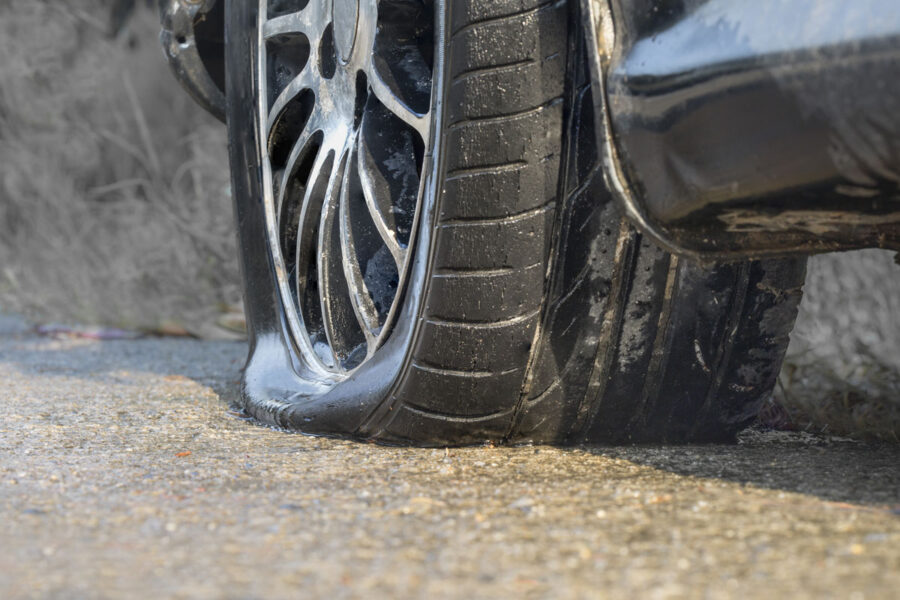

Sometimes. You can replace one tire on an AWD vehicle if the new tire closely matches the other three and falls within the vehicle manufacturer’s allowed tread-depth or circumference difference. Ideally, it should be the same size, brand, model, construction, and rating as the existing tires.
If the difference is too large, one new tire can create a constant wheel-speed mismatch that makes the AWD system keep compensating. Depending on the measurements and condition of the other tires, the best option may be one identical tire, a shaved tire, a pair of tires, or a full set. Before replacing an AWD tire in Brevard, NC, a shop should inspect and measure all four tires.
Why Matching Tires on AWD Vehicles Matters
A tire with deeper tread has a slightly larger overall diameter than the same tire with worn tread. As a result, it travels a little farther with each revolution.
AWD systems are designed to handle temporary differences in wheel speed, such as those that occur while turning or when traction changes. A permanent difference in tire circumference is another matter. If one tire consistently turns at a different rate, the differentials or couplings may continue working to compensate. That can add heat and wear over time.
A small tread variation does not automatically mean there is a problem. It does mean a shop should check the full set and the vehicle manufacturer’s requirements before installing a single replacement.
How Much Tread-Depth Difference Is Acceptable?
There is no universal tread-depth limit for every AWD car, crossover, SUV, or truck. The owner’s manual or vehicle manufacturer’s specifications should guide the decision.
Common screening guidelines call for keeping all four AWD tires within:
- 2/32 inch of one another in tread depth
- 1/4 inch of one another in circumference
These numbers are helpful starting points, but the limits for the specific vehicle take priority.
Tire manufacturers sometimes provide their own guidance. Michelin, for example, says same-size, same-brand, and same-model tires may differ by as much as 5/32 inch in tread depth unless the vehicle manufacturer says otherwise. That does not mean a 5/32-inch difference is suitable for every AWD vehicle.
Suppose three tires measure 7/32 inch and an identical new tire starts at 10/32 inch. The 3/32-inch difference is outside the conservative 2/32-inch guideline. Before installing the new tire at full tread depth, the shop should check the vehicle’s requirements and determine whether shaving the tire or replacing more than one tire makes sense.
Tread depth should be checked in several grooves on each tire. Uneven wear can produce different measurements along the inner edge, center, and outer edge. One reading may not show the full condition of the tire.
When You Can Replace One Tire on AWD
Replacing one tire may be reasonable when the other three are still close to new. If an identical replacement stays within the manufacturer’s permitted tread-depth or circumference difference, there may be no need to replace the full set.
The replacement should match the existing tires in the following areas:
- Tire size
- Brand and model
- Tread design and construction
- Load and speed ratings
- Rolling circumference
- Tread depth
Matching the size printed on the sidewall is not always enough. Two tire models with the same listed size can differ slightly in actual circumference, tread pattern, and construction.
If the original tire model has been discontinued, a different model in the same size may not be a close enough match. In that situation, replacing a pair or the complete set may be more appropriate.
The condition of the remaining tires matters too. Cracking, damage, uneven wear, or tread that is already near the replacement point can make a single-tire solution impractical. If the original damage resulted from a puncture or pressure loss, this guide to the top causes of flat tires and how to prevent them explains several common causes.
Can Tire Shaving Make a Single Replacement Work?
Tire shaving can sometimes allow you to replace one AWD tire without discarding three tires that still have plenty of usable tread.
A specialized machine removes tread rubber from the new tire until its depth more closely matches the other three. This also reduces the difference in rolling circumference.
Shaving may be a practical option when:
- The other three tires still have substantial tread
- The exact replacement tire is available
- A full-depth tire would exceed the vehicle’s permitted difference
- Shaving can bring the replacement within specification
The tire itself still needs to match. Shaving a different tire model does not correct differences in construction, tread pattern, or handling characteristics.
It also makes little sense to shave a new tire to match three tires that are already near the end of their service life. A tire should be removed from service when it reaches 2/32 inch in any groove or when the undertread or cord material is exposed. If the remaining tires are close to that point, replacing all four is generally the more practical option.
When Replacing Two Tires Makes Sense
Replacing two tires can provide a better match across one axle, but it does not automatically correct an AWD circumference mismatch.
A matching pair may work if two tires are noticeably more worn than the other two, as long as all four remain within the vehicle manufacturer’s permitted difference. The shop still needs to measure every tire before deciding that a pair is enough.
Tire manufacturers generally recommend putting the deeper-tread pair on the rear axle. If only one tire is replaced, guidance may call for pairing it on the rear axle with the existing tire that has the deepest tread. Vehicle-specific instructions should still be followed.
Rear placement helps maintain vehicle stability, but it does not take precedence over AWD matching requirements. Two new rear tires and two heavily worn front tires may still create too much difference in circumference.
When Four New Tires Are the Better Choice
Replacing all four tires is usually appropriate when one tire or a new pair cannot keep the set within the vehicle manufacturer’s limits.
A complete set may be recommended when:
- The other three tires have significant wear
- The tread-depth difference exceeds the vehicle’s allowed range
- The tires have uneven wear
- The existing tires are already close to replacement depth
- The exact brand and model are unavailable
- Age, cracking, or other condition concerns affect the remaining tires
- Two new tires would still leave too much difference between the axles
Four matching tires provide consistent size, construction, tread design, and tread depth at each wheel. This avoids combining tires that are too different or trying to preserve tires with little usable life remaining.
That does not mean every puncture or sidewall injury requires four tires. The recommendation should be based on measurements, tire condition, product availability, and the vehicle manufacturer’s instructions.
What Should Be Checked Before Choosing One, Two, or Four Tires?
A proper AWD tire recommendation requires checking more than the damaged tire. Before deciding how many tires to replace, the shop should review:
-
The vehicle manufacturer’s requirements
The owner’s manual or manufacturer guidance may set limits for tire mixing, tread-depth differences, or circumference. -
Tread depth on all four tires
Each tire should be measured in several grooves, especially when uneven wear is visible. -
The exact tire specifications
The shop should compare size, brand, model, construction, load rating, and speed rating. -
Overall tire condition
Cracking, exposed material, damage, and uneven wear can determine whether the remaining tires are worth keeping. -
Actual circumference, if needed
A direct circumference measurement can help confirm whether the tires meet the required limit. -
Inflation pressure
Proper inflation helps each tire maintain its intended shape and rolling circumference. -
Wear across the full set
Differences between axles or across individual tread grooves may affect the recommendation.
After the replacement, correct inflation and regular tire rotation can help all four tires wear more evenly.
So, can you replace just one tire on an AWD vehicle? Yes, if it closely matches the other three and meets the manufacturer’s limits. When it does not, tire shaving, a matching pair, or four new tires may be the better answer. A Brevard tire shop should measure the full set before making that call.