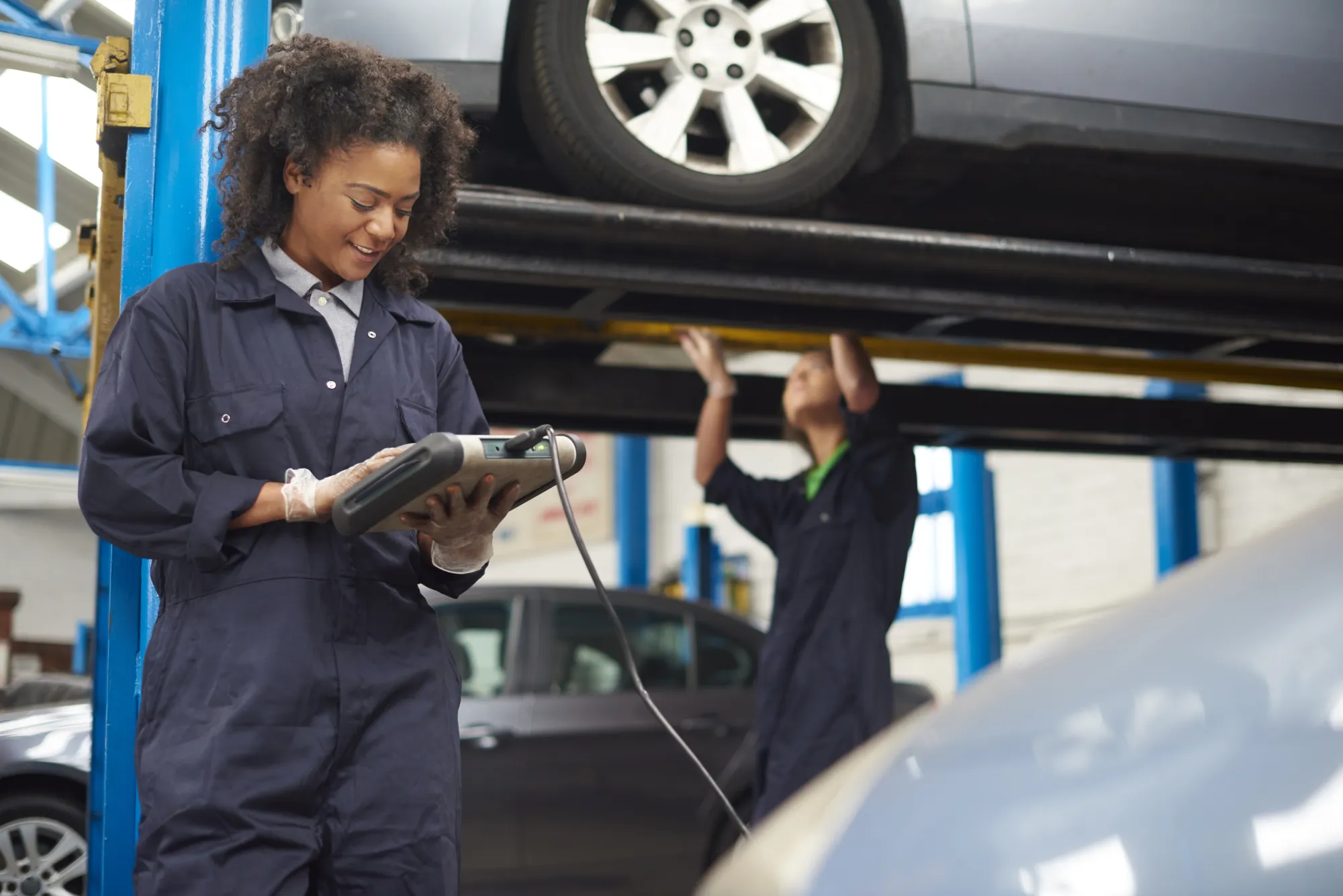
The wheel comes off and you can read the whole trip in the parts.
When a vehicle rolls into our shop in Brevard with a complaint of “the pedal got weird coming down the mountain,” a technician often knows what happened before the owner finishes the sentence. The pad faces are glassy, almost mirror-bright, instead of the dull gray they should be. The rotors have gone straw or blue-purple across the swept area, and under good light there are fine cracks like crazing on an old coffee mug. The fluid in the reservoir is dark instead of pale amber.
None of those parts failed. Every one of them got too hot and stayed too hot, and that is a different problem with a different fix.
So this post runs backwards: the lift first, then the heat, then the driving habit behind it.
What a Cooked Brake System Looks Like on the Lift
Glazed pads
Friction material is supposed to be slightly rough and slightly crumbly. That texture is where the grip comes from. Cook it and the surface partially melts, then re-hardens into a smooth, hard skin, and you press the same but get less. A glazed pad still has plenty of material left, which is why owners are surprised when we condemn it. Thickness is not the problem. The surface is.
Heat tint and heat checking on the rotors
Cast iron changes color when it has been hot, and that color is a record. The fine surface cracking that comes with it is called heat checking, and it is a discard condition rather than a machining job. Turning the rotor only removes the visible portion of a crack that runs deeper than the cut. Thickness matters for the same reason: every rotor carries a minimum cast into the hat or hub plate, and one worn down to it has lost the thermal mass it needs to survive a long descent, so it fades sooner and cracks again faster.
Dark brake fluid
Fluid does not darken the way engine oil gets dirty. It darkens with age, heat, and moisture, and moisture is the part that matters most on a mountain road.
Discolored hardware and caliper slides
Scorched anti-rattle clips and dried-out slide pin grease tell you the caliper body soaked up serious heat, which means so did everything inside it.
Any one of those is a conversation. All four is a vehicle that came down a long grade on its brakes.
Why the Descent Into Brevard Is Harder on Brakes Than It Looks
US 276 runs northwest out of Brevard through Pisgah National Forest, follows the Davidson River upstream, climbs Pisgah Ridge, and crosses the Blue Ridge Parkway at the top. That junction is milepost 412, and NC 215 meets the Parkway at milepost 422.4. Both are part of the Forest Heritage Scenic Byway, and the byway carries 9% grades. That is steep enough that most truckers slow to as little as 15 miles per hour, and steep enough that the route is not recommended for recreational vehicles or buses at all.
Southbound is no gentler. From Brevard, US 276 climbs about 2,000 feet to Caesars Head State Park and crosses the Eastern Continental Divide at 2,910 feet. If you live in Cedar Mountain, that grade is not a scenic drive. It is your commute.
Going up, your engine does the work and the heat leaves through the tailpipe and radiator, which are built to shed heat all day. Coming down, gravity feeds energy into the vehicle continuously, and if all you are doing about it is holding the pedal, that energy has one place to go: into your pads and rotors, as heat.
Heat Soak: Where the Energy Actually Goes
A brake rotor is a heat sink. On flat ground that works beautifully, because you brake for four seconds at a stoplight and then get thirty seconds of airflow to cool off.
A 9% grade takes the recovery time away. The first mile is fine. Somewhere around the third, the math turns against you, because every brake application now starts with a rotor that is already hot. Weight makes it worse: a loaded pickup or a family car with a weekend of gear has more energy to shed, and all of it lands on the same parts.
Then the heat moves. Rotor to pad, pad to caliper piston, piston to the brake fluid sitting right behind it. That last step is the one nobody sees, and it causes the scariest symptom.
One more failure shows up a week later. Come down hot, then stop at a light in Pisgah Forest and hold the pedal. A stationary hot pad against a stationary hot rotor transfers material to one spot, and that spot is now a few ten-thousandths of an inch thicker than the rest of the disc. That is the shudder in the steering wheel out on US 64 toward Penrose the following week.
Why a Brake Fluid Flush in Brevard Matters More Than It Does on Flat Ground
Brake fluid is hygroscopic. It pulls moisture out of the air, slowly and continuously, through hoses and seals and past the reservoir cap. Federal brake fluid labeling has told people for decades to keep it clean and dry and to keep containers tightly closed to prevent absorption of moisture.
The federal standard, FMVSS 116, publishes two boiling points for every grade, and the gap between them is the whole story:
- DOT 3: minimum 205 C (401 F) new and dry, but only 140 C (284 F) once wet
- DOT 4: minimum 230 C (446 F) dry, 155 C (311 F) wet
“Wet” there means fluid brought to 3.70 percent water by weight, and fluid is generally considered saturated right around that mark.
How fast does real fluid get there? Typical service data has it absorbing up to 2 percent water after one year, 3 percent by about 18 months, and 7 to 8 percent after several years. The effect is dramatic: 1 percent water drops a typical DOT 3 fluid to around 369 F, 2 percent to roughly 320 F, and 3 percent to 293 F. An NHTSA survey of 1,720 vehicles found the fluid in 20 percent of them contained 5 percent or more water.
So fluid that shipped with a 401 F floor may be running with a 293 F ceiling. On a 9% grade with the pads cooking, that is a number you can reach. When brake fluid boils it makes vapor, and vapor compresses in a way liquid does not, so pressing the pedal squeezes the bubble instead of the pads. The pedal can travel a long way down, or all the way to the floor, without applying the brakes.
Intervals vary, and many imports call for replacement in the 24 to 36 month range. Your owner’s manual governs. If your week includes the Parkway, Caesars Head, or the run down through Rosman, a brake fluid flush in Brevard belongs on the calendar rather than waiting for a symptom.
Normal at the Top, Long at the Bottom
At the overlook the pedal is firm and high. Three miles down, past Looking Glass Falls, it feels a little softer and you press harder without thinking about it. Near the bottom, coming into Pisgah Forest, it goes long, and your foot travels somewhere it has never traveled before.
You can usually tell the two failures apart by feel:
- Pad fade is a firm pedal that does not do much. The pressure is there, the friction is not.
- Fluid fade is a pedal that sinks. It feels soft or bottomless, and pumping may bring it back for a moment.
Both are heat. Both mean the system was asked for more than it had left.
Driving It Differently: The Gear Goes In at the Top
The fix is not better brake technique. It is using the brakes less, and you do that with the engine. The mountain driving doctrine used to train commercial drivers is blunt about it: on a long or steep downgrade, the brakes are only a supplement to the braking effect of the engine.
Select the low gear before you start down
This is the habit people get wrong. Do not wait and try to downshift after speed has already built, because by then the gear is harder to get and you have already put heat in. Choose it at the overlook. In a modern automatic that means L, 2, or the manual-shift or tow/haul mode instead of D. In a CVT, look for the low or B position. The engine will sound busier than you are used to, and that noise is work getting done somewhere other than your rotors.
Then snub the brakes instead of riding them
- Pick a safe speed for the grade and the curves.
- Apply the brakes firmly enough to feel a definite slowdown.
- Hold about three seconds, until you are roughly five mph below that safe speed.
- Release completely and let the engine hold you while the brakes cool.
- When speed builds back to your safe speed, repeat.
Firm and brief beats light and constant. Continuous light pressure is the worst option available, because it never lets go long enough for air to carry heat away. Our post on making your brakes last longer covers the everyday-driving side of the same idea.
Brake Service in Transylvania County: What a Tech Inspects and Measures Afterward
Brake service in Transylvania County after a hard descent is a measuring job, not a look-and-guess job. If you are searching for a brake shop near you after a rough trip down the mountain, this is the checklist worth asking about:
- Pad material remaining and pad surface condition. Thickness gets measured, but glazing is a separate and equally decisive question.
- Rotor thickness against the discard spec cast into the part. Measured with a micrometer, not calipers.
- Disc thickness variation. Taken at six to eight equidistant points about 0.40 inch in from the outer edge. Allowable variation is generally no more than 0.0005 inch.
- Lateral runout. Read with a dial indicator on a stationary mount, wheel fasteners fully torqued. Most applications allow about 0.001 to 0.002 inch.
- Rotor surface condition. Heat tint, heat checking, hard spots, scoring.
- Brake fluid moisture test. A direct read rather than a guess based on age.
- Hoses, caliper slides, hardware, and the parking brake. Heat is hard on rubber and grease.
Those measurements decide whether a rotor can be resurfaced or has to be replaced, and whether you need pads, pads and rotors, a fluid flush, or all of it. That is also where people ask what it will run. We do not put numbers in a blog post, because parts and labor pricing moves and a stale figure is worse than no figure. Request a current quote or call the shop, and you will get one for your actual vehicle and your actual measurements. Our brake service page lists what is included.
Symptoms That Mean Stop Driving and Book Service Now
Some brake complaints can wait. These cannot.
- The pedal sinks toward the floor, or you have to pump it to get a firm pedal.
- A hot or burning smell combined with a soft pedal.
- The brake warning light is on.
- The vehicle pulls hard to one side when you brake.
- Grinding, or a metallic scrape that got worse during the descent.
- A new pulsation or shudder under braking that was not there this morning.
If it starts while you are on the grade, pull off at the first safe spot and let the brakes cool. Then decide, honestly, whether you are driving it home or calling for a tow.
Brakes and the North Carolina Annual Inspection
Every vehicle registered in North Carolina has to pass an annual safety inspection before the registration renews, and that inspection covers the foot brake and the parking brake as separate items. A vehicle that lives on flat ground and a vehicle that runs Caesars Head every month should not be on the same brake schedule. Pedal feel in town is not a test of what the system has left on a 9% grade.
Book Brake Repair in Brevard, NC Before the Next Trip Up
If you have come down US 276 or off Caesars Head recently and something about the pedal, the smell, or the steering wheel is different, get it looked at now rather than after the next descent. Brake repair in Brevard, NC is straightforward when it is caught at the glazing-and-fluid stage, and a good deal less so once rotors are cracked. We see this every season from Pisgah Forest and Penrose to Rosman, Cedar Mountain, and the Hendersonville side.
Schedule an appointment with our team and we will measure the whole system, test the fluid, and tell you plainly what it needs.